
T5018 Slips: What Every Okanagan Contractor Needs to Know Before CRA Comes Knocking
Most trades businesses in the Okanagan have never filed a T5018, and CRA knows it. Learn what it is, who needs to file, and what the penalties look like when you don't.
In 2018, the Tax Court of Canada heard a case involving a business that paid a general contractor significant sums over three consecutive years to carry out construction work on its behalf. When CRA assessed penalties for missing T5018 Summary filings, the business pushed back, arguing it was in the business of selling, not building, and therefore the rule didn't apply.
The court disagreed. Penalties of $2,500 were upheld for each of the three years in question. Total cost: $7,500. All because of a filing requirement the business didn't know, or didn't believe, applied to them.
If you run a trades or construction business in Kelowna or anywhere across the Okanagan, this case matters to you. Here's what you need to know.
What Is a T5018?
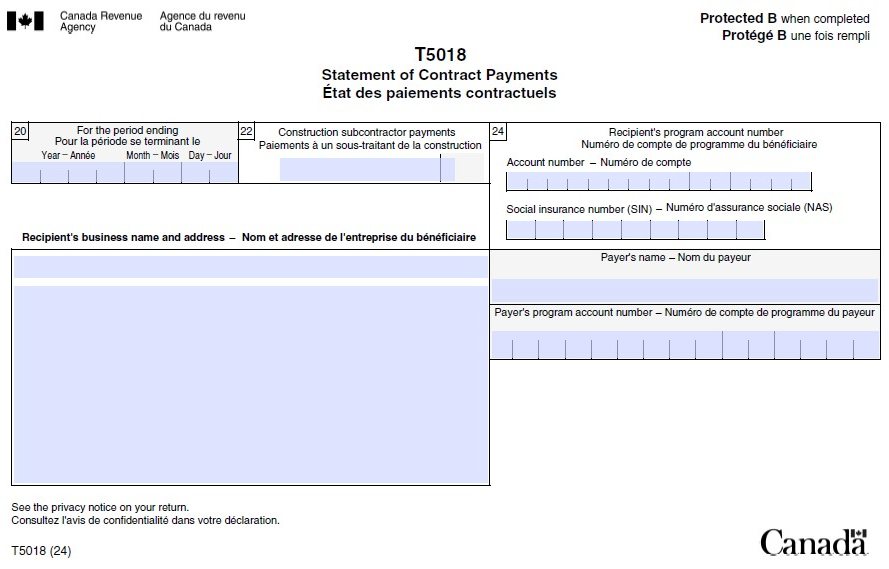
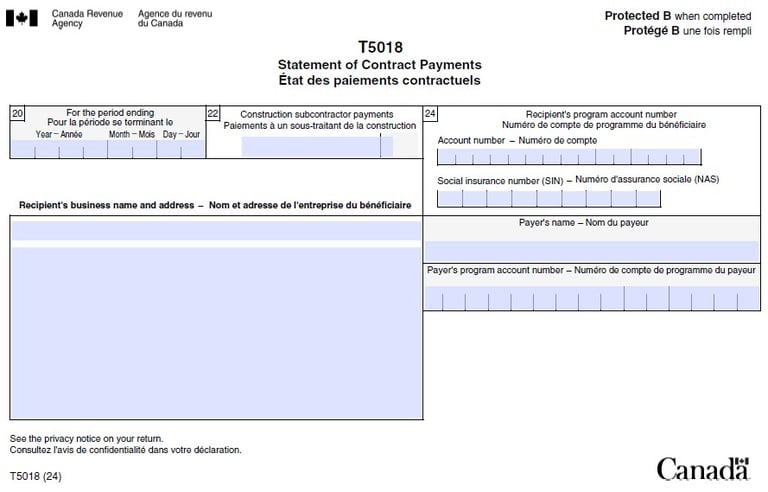
The T5018, formally known as the Statement of Contract Payments, is a CRA information slip that reports payments made to subcontractors for construction services. Think of it like a T4 for employees, but for the subcontractors you hire to do work on your behalf.
When you file a T5018, you are telling CRA: "I paid this person or company X amount for construction services this year." CRA uses that information to cross-reference what your subcontractors report on their own tax returns. It is one of the primary tools CRA uses to track the underground economy in the construction industry, which is why they take non-compliance seriously.
Who Is Required to File a T5018?
This is where most trades business owners get tripped up. The requirement applies when more than 50% of your business income comes from construction activities and you pay a subcontractor $500 or more (excluding GST) in a reporting period.
CRA's definition of "construction activities" is broad. It includes:
General contracting and subcontracting
Landscaping and excavation
Framing, drywall, and roofing
Plumbing, electrical, and mechanical
Paving, concrete work, and site preparation
Renovation and restoration work
The court case referenced above is a clear illustration of just how broadly CRA interprets this definition. The business in question was not a general contractor. It was a developer selling completed units and argued the construction was incidental to its real business of selling. The court found that because construction was integral to generating their revenue, the T5018 requirement applied.
If your business generates more than half its income from any form of construction activity and you pay subcontractors, you almost certainly need to be filing T5018s.
The Deadline and How Filing Works
T5018 Summaries and slips are due six months after the end of your reporting period. For businesses using the calendar year, that means June 30. This is an important detail many contractors get wrong.
You file a slip for each subcontractor, along with a T5018 Summary that totals all payments made during the period.
You also need to provide each subcontractor with a copy of their slip. Most accounting software platforms including QuickBooks and Sage generate T5018 slips directly from your subcontractor payment register.
What Happens If You Miss the Deadline?
The penalty for failing to file a T5018 Summary on time is $25 per day, starting the day it was due. The minimum penalty is $100 and the maximum is $2,500 per Summary.
That might sound manageable for a single missed filing. But consider a trades business that has missed Summaries for multiple years. The penalties compound quickly, and CRA can reassess multiple years if they discover the non-compliance during an audit.
The 2018 Tax Court case involved three years of missing T5018 Summaries. Three filings, three maximum penalties, $7,500 total. The business lost at every level.
It is worth noting that CRA maintains a list of high-risk industries for audit purposes. Construction has been on that list for years. If you are a trades contractor in Kelowna or the Okanagan and your books are reviewed, T5018 compliance will be one of the first things checked.
If you know you have missed prior years, CRA's Voluntary Disclosures Program may allow you to get compliant while reducing or eliminating penalties. Coming forward before CRA contacts you is always the better path.
The Most Common Mistakes Trades Businesses Make
Based on what we see working with trades and construction businesses across the Okanagan, the most common T5018 mistakes are:
Not knowing the rule exists. The T5018 requirement is not widely publicized, and many contractors have operated for years without ever filing one. Not knowing the rule is not a defence CRA accepts.
Misunderstanding the 50% threshold. Some trades business owners assume the rule doesn't apply because they do other types of work. If more than half your income comes from construction activities, the obligation applies regardless of what else you do.
Misidentifying who counts as a subcontractor. If you pay someone to perform construction services and they invoice you rather than receiving a regular paycheque, they are likely a subcontractor for T5018 purposes, regardless of how you describe the relationship.
Filing late or not at all after a business grows. Many trades businesses start small and add subcontractors as they grow. T5018 obligations often get missed during that growth phase before proper accounting systems are in place.
How to Stay Compliant
Staying on top of T5018 obligations does not have to be complicated. The key is having a system in place from the start of each reporting period rather than trying to reconstruct subcontractor payment records at filing time.
Practically, this means: Collecting the business number or SIN of every subcontractor before their first payment. You need this information to complete the slip and it is much harder to track down after the fact.
Tracking subcontractor payments separately in your bookkeeping software throughout the year. This makes generating the T5018 slips at filing time straightforward rather than a scramble.
Setting a calendar reminder for your filing deadline every year. The deadline does not move, and the penalty starts the day after.
If you are unsure whether your current subcontractor relationships trigger the T5018 requirement, that is a question worth answering before CRA answers it for you.
How Murtagh & Co. Can Help
At Murtagh & Co. Financial Services, we handle T5018 filings for trades and construction businesses across the Okanagan every year. We track subcontractor payments throughout the year, prepare and file the Summaries and slips on time, and make sure your business stays on the right side of CRA's compliance requirements.
We also review subcontractor relationships to flag any potential misclassification risk, because the T5018 requirement and the employee versus subcontractor question often go hand in hand.
If you are not confident your T5018 obligations are being handled correctly, or if you have never filed one and are not sure where you stand, reach out for a free initial consultation. No pressure, no jargon, just a straightforward conversation about where your business stands.
Murtagh & Co. Financial Services serves trades and construction businesses in Kelowna, West Kelowna, Lake Country, Vernon, Penticton, and across BC remotely.